
How Guardian Mail delivers rapid, measurable ROI by stopping threats at the edge before they ever reach your infrastructure.
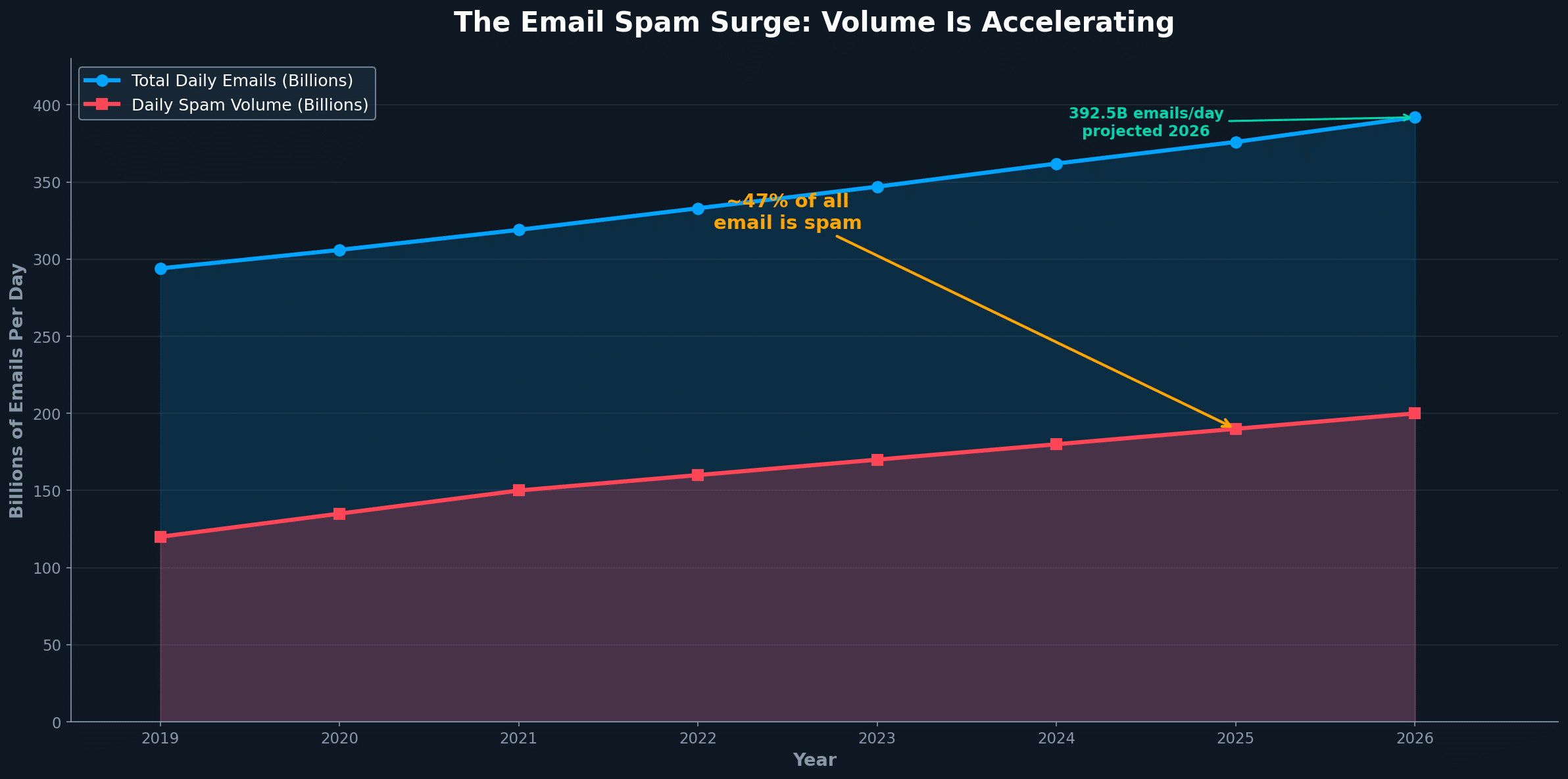
The numbers should unsettle every security leader paying attention. Global email volume is projected to hit 392.5 billion messages per day in 2026, with spam now accounting for nearly 47% of all traffic. Over 3.4 billion phishing emails are sent daily. And the average cost of a phishing-related data breach has climbed to $4.88 million — up nearly 10% year over year.
For CISOs and security architects, this isn't just a nuisance problem. It's a compounding operational and financial risk that demands a fundamentally more efficient response. The question isn't whether to invest in email security. It's whether your current approach delivers enough return on that investment to keep pace with a threat landscape that's evolving faster than most defenses can adapt.
The Economics of Inaction
Email remains the primary attack vector for cybercrime, and the economics are getting worse. Business Email Compromise (BEC) alone accounted for $2.77 billion in reported losses in the U.S. in 2024. Phishing-driven financial losses nearly quadrupled year over year — from $18.7 million to $70 million — and are projected to surpass $25 billion annually by 2026.
But the headline-grabbing breach costs tell only part of the story. The hidden tax on most organizations is operational: security analysts buried in alert triage, IT teams managing quarantine queues, infrastructure straining under the weight of processing billions of unwanted messages that should never have reached the network in the first place.
This is the fundamental inefficiency that most email security architectures fail to address. Traditional secure email gateways (SEGs) and post-delivery scanning tools operate deep inside the mail flow. They accept the message, inspect it, and then decide what to do. By the time a threat is flagged, your servers have already spent compute cycles processing it, your bandwidth has been consumed, and your analysts are reviewing yet another alert.
The ROI conversation changes dramatically when you move the decision point upstream.
Why Architecture Matters More Than Features
Security leaders are not short on options when it comes to email protection. The market is crowded with solutions that promise AI-powered detection, sandbox analysis, and sophisticated content inspection. Many of these tools are effective at what they do. But effectiveness at the point of detection is only one variable in the ROI equation.
The other — and arguably more consequential — variable is where in the mail flow that detection happens.
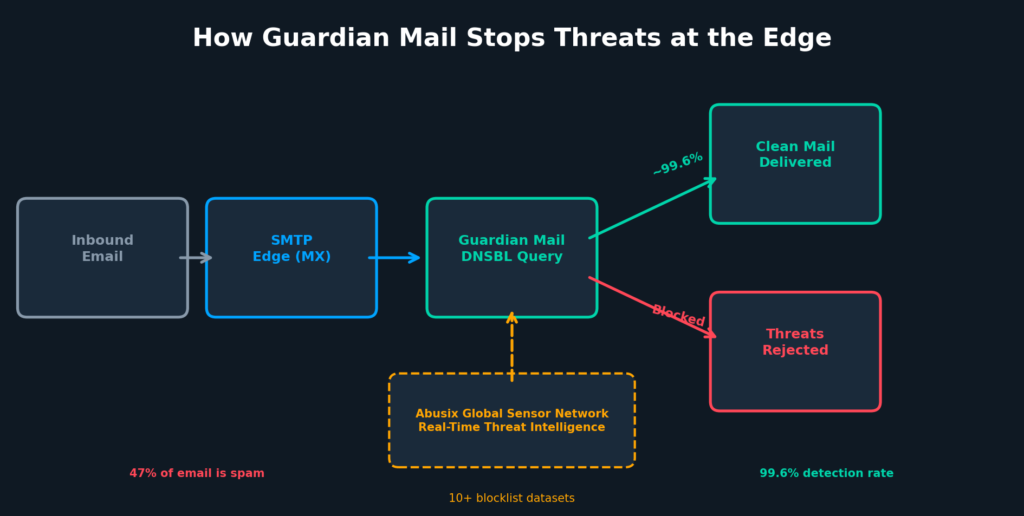
This is where Guardian Mail by Abusix takes a fundamentally different approach. Guardian Mail operates as a DNS-based blocklist (DNSBL) layer that integrates directly at the SMTP edge — the very first decision point in the email delivery chain. Before a message is accepted, before it consumes server resources, before it enters any scanning pipeline, Guardian Mail queries its real-time threat intelligence to determine whether the sender should be allowed through.
The architecture is elegantly simple and operationally powerful. Because it works as an RFC-5782 compliant DNS lookup, it integrates with virtually any SMTP server, anti-spam appliance, or email security stack without requiring new hardware, agents, or a rip-and-replace migration. You add your API key, configure your MX hosts to query the service, and start blocking threats within minutes — not weeks.
This isn't a marginal improvement. It's a structural advantage that compounds across every metric security leaders care about: detection rate, false positive rate, analyst workload, infrastructure cost, and time to value.
The ROI Case: By the Numbers
Guardian Mail's architecture translates directly into measurable financial returns, and the data backs it up.
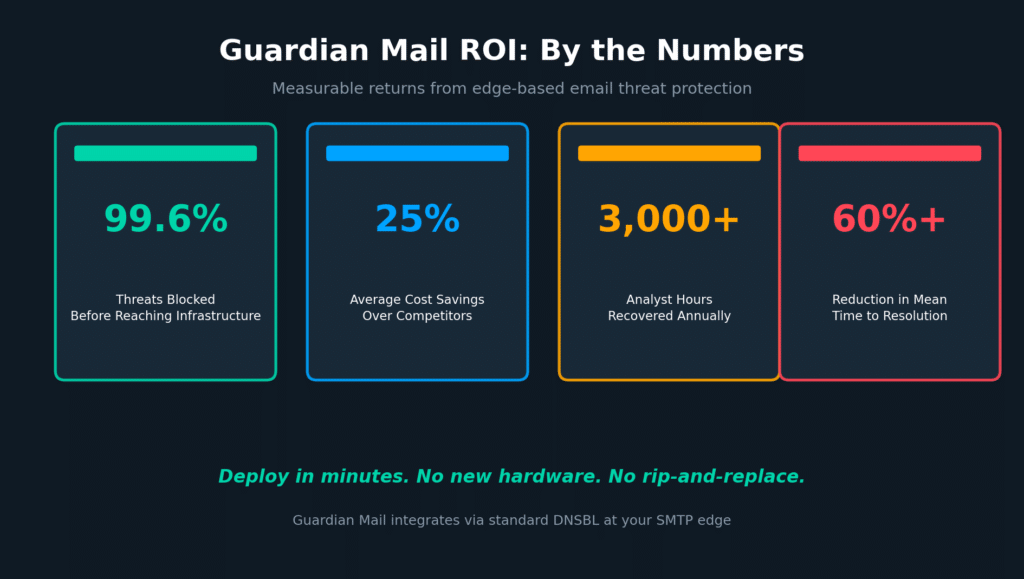
Detection efficacy above 99.6%. Guardian Mail blocks more than 99.6% of email-borne threats — spam, phishing, malware, and BEC attempts — before they reach your infrastructure. That percentage matters enormously at scale. For an organization processing millions of messages per day, the difference between 99% and 99.6% detection is tens of thousands of threats that either get through or don't.
25% average cost savings over competitors. Because Guardian Mail operates as a lightweight DNS query layer rather than a resource-intensive inline appliance, its total cost of ownership is significantly lower. Organizations report an average 25% reduction in email security spending compared to traditional SEG-based approaches.
3,000+ hours of analyst time recovered annually. By eliminating the vast majority of threats before they generate alerts, Guardian Mail dramatically reduces the triage burden on security teams. That's the equivalent of more than 1.5 full-time analysts redirected from email alert fatigue to higher-value security work.
60%+ reduction in mean time to resolution. When threats are stopped at the edge, there are fewer incidents to investigate, fewer endpoints to remediate, and fewer users to retrain. The result is a measurable compression in MTTR across the email threat category.
Deployment in minutes, not months. Because Guardian Mail integrates via standard DNSBL or RSYNC feeds, organizations go from evaluation to production protection in a fraction of the time required by traditional solutions. There's no complex onboarding, no infrastructure overhaul, no prolonged proof-of-concept cycle eating up your team's bandwidth.
What Powers the Intelligence
A blocklist is only as good as the data behind it, and this is another area where Guardian Mail differentiates. Abusix's threat intelligence is sourced from a global sensor network that continuously monitors abuse, spam, phishing, and malware infrastructure across the internet. This isn't recycled third-party data — it's proprietary, real-time intelligence that reflects the current state of the threat landscape.
Guardian Mail provides more than 10 distinct blocklist datasets covering IP addresses, domains, short URLs, drive URLs, bitcoin wallet addresses, email addresses, and hashed datasets. This breadth of coverage means threats are identified and blocked across multiple vectors simultaneously, not just at the IP level.
The intelligence is updated continuously, which is critical in an environment where threat actors spin up and abandon infrastructure in hours. A blocklist that updates daily — or worse, weekly — is a blocklist that misses the threats that matter most. Guardian Mail's real-time feeds ensure that the moment a malicious sender is identified anywhere in the global network, that intelligence is available to every customer querying the service.
The AI-Driven Threat Multiplier
The spam surge isn't just about volume — it's about sophistication. AI-generated phishing emails have driven a staggering 1,265% increase in phishing attempts. These aren't the poorly formatted, typo-laden messages that legacy filters catch with simple heuristics. They're contextually relevant, grammatically polished, and increasingly personalized.
This evolution makes upstream filtering even more critical. The longer a sophisticated phishing email lives inside your infrastructure — passing through scanning layers, sitting in quarantine queues, potentially reaching an inbox — the higher the probability of a successful compromise. Guardian Mail's edge-based approach reduces this dwell time to zero for the vast majority of threats, because the message is rejected before it enters the environment at all.
For the subset of threats that do require deeper inspection, Guardian Mail serves as the high-efficiency first layer that dramatically reduces the workload on downstream tools. Your SEG, your sandbox, your AI-powered content analyzer — they all perform better and cost less when they're only processing the fraction of mail that survives initial edge filtering.
A Practical Deployment Path for Security Leaders
One of the most underappreciated aspects of Guardian Mail's ROI is the deployment model itself. Security leaders know that the total cost of a solution includes not just the license fee, but the engineering hours to deploy, the operational overhead to maintain, and the opportunity cost of a prolonged rollout.
Guardian Mail sidesteps most of these costs entirely. The integration path is straightforward: configure your edge mail servers to query Abusix's DNSBL service, apply the recommended blocklist datasets for inbound (and optionally outbound) filtering, and you're operational. The service supports all major mail platforms — Postfix, Sendmail, Exchange, and any SMTP server that supports DNSBL lookups.
There's no new appliance to rack, no agent to deploy to endpoints, no cloud proxy to route your mail through. Your existing architecture stays intact. Guardian Mail simply makes it smarter at the first decision point.
The Bottom Line
The spam and phishing epidemic is not slowing down. Volume is increasing, sophistication is accelerating, and the financial consequences of a successful email-borne attack continue to climb. Security leaders who rely solely on deep-inspection tools operating inside the mail flow are fighting an increasingly expensive battle on unfavorable terrain.
Guardian Mail offers a different strategic posture: stop the majority of threats before they enter your environment, reduce operational burden on your team, lower your total cost of email security, and do it all with a deployment measured in minutes rather than months.
In an era where every security dollar needs to deliver measurable value, Guardian Mail's architecture-first approach to email protection isn't just a technical advantage — it's a financial one.
Ready to see the ROI for your organization? Learn more about Guardian Mail or explore the full email threat protection solution.
Abusix Guardian Mail is trusted by email operators and security teams worldwide to deliver real-time, edge-based email threat protection with industry-leading detection rates and rapid time to value.


